
Generator repair and maintenance in Henderson, NV
Generator repair and maintenance in Henderson, NV helps you restore a standby generator that will not start, shuts down unexpectedly, displays fault codes, fails to transfer backup power, or needs scheduled maintenance. Bright Wave Electric can dispatch a licensed electrician to inspect the generator system, diagnose electrical faults, test starting and charging components, evaluate the automatic transfer switch, complete authorized repairs or maintenance work, and verify generator operation.
You can request service for generator troubleshooting, preventive maintenance, battery and charging-system problems, electrical component failures, transfer-switch faults, and post-service operational testing at your Henderson home or business.
Call +1 (725) 313-2488 to request generator repair and maintenance in Henderson, NV.
- Licensed Electricians
- Generator Diagnostics & Troubleshooting
- Scheduled Generator Maintenance
- Battery & Charging System Testing
- Automatic Transfer Switch Testing
- Generator Repair & Component Replacement
- Post-Service Operational Testing
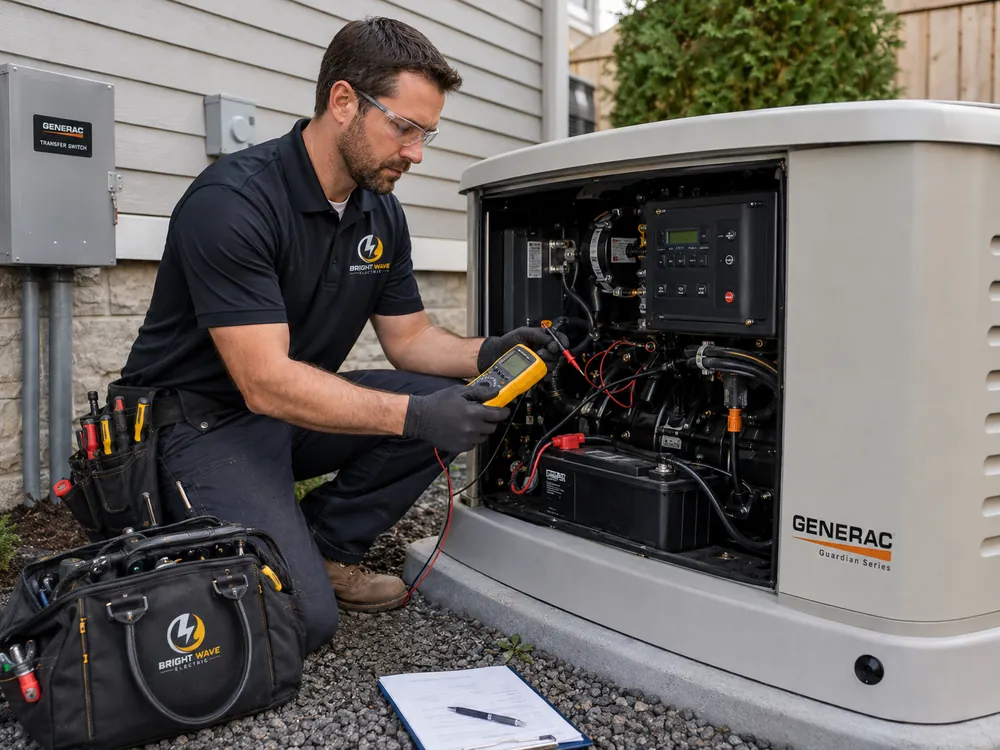
How can you request generator repair and maintenance in Henderson, NV?
You can request generator repair and maintenance in Henderson, NV by calling Bright Wave Electric at +1 (725) 313-2488.
Schedule service when your generator will not start, shuts down, fails to transfer backup power, displays a fault, needs electrical troubleshooting, or reaches its required maintenance interval.
Call +1 (725) 313-2488 to request generator repair and maintenance for your Henderson home or business.
- Emergency electricians24/7
- Service areaHenderson & Las Vegas Valley
- Work coveredResidential & commercial
Thanks — we’ll be in touch about your electrical service.
What generator problems can you request Bright Wave Electric to diagnose and repair?
You can request Bright Wave Electric to diagnose generator problems that prevent the system from starting, running correctly, transferring backup power, or completing its normal operating cycle.
Common generator problems include:
- Generator will not start or crank
- Generator starts and then shuts down
- Generator fails its scheduled exercise cycle
- Generator runs but does not supply backup power
- Automatic transfer switch does not transfer power
- Fault codes, warning lights, or controller alarms
- Weak or failed generator battery
- Battery charger or charging-circuit problems
- Starter or starting-circuit problems
- Loose, damaged, or corroded electrical connections
- Controller, sensor, or control-circuit faults
- Irregular generator voltage or frequency
- Repeated generator shutdowns
- Generator does not return to standby operation correctly
A licensed electrician can test the affected system before recommending repair, so you correct the actual fault instead of replacing working components.
What does generator repair involve?
Generator repair involves diagnosing the failed system or component, completing the appropriate corrective work, and testing the generator after the repair.
Depending on the fault, a licensed electrician can inspect and troubleshoot:
- Generator battery and charging circuit
- Starting circuit
- Electrical wiring and connections
- Control wiring
- Generator controller
- Fault codes and stored alarms
- Sensors and related controls
- Automatic transfer switch
- Generator electrical output
- Voltage and frequency
- Breakers and generator disconnects
- Other accessible electrical components connected to generator operation
The electrician can repair, adjust, reset, or replace affected components when the diagnostic results support that work and you authorize the repair.
How does a licensed electrician diagnose a generator problem?
A licensed electrician diagnoses a generator problem by testing the starting, charging, control, output, and transfer functions needed for the generator to operate correctly.
The diagnostic process can follow these steps:
- Inspect the generator and connected electrical equipment. The electrician checks accessible wiring, connections, controls, breakers, the battery system, and transfer equipment for visible problems.
- Review generator faults and alarms. The electrician checks available fault codes, warning indicators, controller information, and operating history that can help identify the failure.
- Test the starting and charging system. The electrician evaluates the battery, charger, starting circuit, and related electrical connections when the generator has trouble starting.
- Test generator operation and electrical output. The electrician starts the system when conditions allow and checks whether the generator produces the expected electrical output.
- Evaluate transfer operation. When the reported problem involves backup-power transfer, the electrician tests the automatic transfer switch and related control circuits.
- Identify the failed component or electrical condition. The electrician uses the test results to determine the corrective work the generator system requires.
- Complete authorized repairs and verify operation. After you approve the repair, the electrician completes the work and tests the affected generator functions again.
This sequence connects the reported generator problem to measurable system conditions before component replacement begins.
What generator maintenance can you schedule?
Scheduled generator maintenance can involve inspection, testing, electrical checks, and manufacturer-required service based on your generator model, operating hours, condition, and service interval.
Scheduled maintenance can involve:
- Generator condition inspection
- Battery inspection and testing
- Battery-terminal inspection and cleaning
- Battery-charger testing
- Electrical-connection inspection
- Control-panel and alarm review
- Wiring and control-circuit inspection
- Automatic transfer switch inspection
- Operational testing
- Generator-output testing
- Oil service when required
- Oil-filter replacement when required
- Air-filter inspection or replacement when required
- Spark-plug service when applicable
- Cooling-system inspection on applicable generators
- Leak and corrosion checks
- Intake and exhaust inspection
- Service-record documentation
A licensed electrician can inspect, test, clean, service, or replace the applicable generator components according to the system’s maintenance requirements.
The required maintenance tasks depend on the generator manufacturer, model, engine type, runtime, operating environment, and previous outage runtime.
How much does generator repair and maintenance cost in Henderson, NV?
Routine generator maintenance in Henderson, NV typically starts around $200, while repair pricing depends on the diagnostic work, failed component, required parts, and electrical fault affecting the generator system.
Routine generator maintenance commonly ranges from $200 to $500 per visit. Annual maintenance plans can range from approximately $300 to $700, while more extensive biannual or priority service plans can reach $400 to $900 per year depending on the service frequency and testing provided.
What does generator maintenance typically cost?
| Service | Typical cost | Service scope |
|---|---|---|
| Annual air-cooled standby generator maintenance | $200-$450 | Can involve oil and filter service, air-filter replacement, spark-plug service, battery testing, electrical inspection, and transfer-switch testing when applicable. |
| Annual liquid-cooled generator maintenance | $450-$800 | Can require additional inspection and maintenance because larger liquid-cooled systems use additional cooling, electrical, and control components. |
| Annual maintenance plan | $300-$700 per year | Scheduled preventive maintenance based on the generator model, operating hours, manufacturer’s requirements, and service frequency. |
| Biannual or priority maintenance plan | $400-$900 per year | Can provide two scheduled maintenance visits plus additional benefits offered under the plan. |
What do common generator repairs typically cost?
| Repair | Typical cost | Repair scope |
|---|---|---|
| Generator diagnostic service call | $120-$250 | Testing can involve battery voltage, fault codes, starting circuits, generator output, electrical connections, and transfer equipment. |
| Starter battery replacement | $150-$350 | Replacement of a failed starting battery, along with terminal inspection and cleaning when required. |
| Automatic transfer switch repair | $250-$850 | Diagnosis and repair of transfer controls, contactors, switches, control wiring, or related electrical components. |
| Voltage regulator replacement | $200-$600 | Replacement when testing identifies a failed regulator causing unstable, high, or low generator output. |
| Generator control board replacement | $450-$1,100 | Replacement of a failed generator controller or logic board when diagnostics confirm the component has failed. |
Generator repairs can range from approximately $150 to $1,200 or more when the problem involves electrical controls, transfer equipment, multiple failed components, or extensive diagnostics. Bright Wave Electric can diagnose the generator before you authorize the repair so the recommended work matches the identified fault.
How often should you schedule generator maintenance?
You should schedule generator maintenance according to the manufacturer’s requirements for your generator model, operating hours, and actual outage use.
Many standby generators receive routine service on an annual schedule, but extended generator operation during an outage can trigger maintenance sooner. Generator age, operating environment, previous faults, and accumulated run hours can also affect the service interval.
You can request Bright Wave Electric to inspect the generator and determine which maintenance tasks the system currently requires.
Does a weekly generator exercise replace scheduled maintenance?
A weekly generator exercise does not replace scheduled generator maintenance because a short exercise cycle cannot verify every component or operating condition required during an actual outage.
A generator can start and run during its scheduled exercise while a separate problem affects the battery, charging system, electrical connections, controls, automatic transfer switch, or loaded operation.
Scheduled maintenance allows the electrician to inspect those systems, service required components, review fault information, and perform the appropriate operational tests.
Why can a generator run without supplying backup power to your home or business?
A generator can run without supplying backup power when a fault prevents electrical output from reaching the connected circuits or automatic transfer equipment.
Possible electrical causes can involve:
- Automatic transfer switch faults
- Transfer-control problems
- Generator breaker problems
- Damaged or loose electrical connections
- Control wiring faults
- Generator output problems
- Voltage or frequency faults
- Other problems between the generator and connected electrical system
A licensed electrician can test the generator output and transfer equipment to determine why the generator runs without restoring backup power.
What does automatic transfer switch testing verify?
Automatic transfer switch testing verifies whether the generator and transfer equipment can coordinate the change between utility power and generator power.
When transfer testing forms part of the authorized service, the electrician can evaluate whether the transfer switch detects a loss of utility power, communicates with the generator, transfers the connected load to generator power, and retransfers the connected load to utility power after utility service returns.
A generator that starts successfully can still leave your property without backup power when the transfer switch or related controls fail.
Does generator maintenance require load or transfer testing?
Generator maintenance can require operational, transfer, or loaded testing when the generator model, reported problem, maintenance procedure, or authorized service scope requires that verification.
A basic start-and-run test does not provide the same information as an automatic transfer test or a test that places the generator under electrical load.
Depending on the work the electrician performs, testing can help verify:
- Generator starting
- Stable generator operation
- Electrical output
- Voltage and frequency
- Automatic transfer-switch operation
- Transfer to generator power
- Return to normal utility operation
- Generator performance under load
The electrician should select the test that matches the generator system and the work being performed rather than treating every generator test as the same procedure.
When should you request generator repair instead of routine maintenance?
You should request generator repair when the system has an active fault, operating problem, failed component, or performance issue that routine maintenance alone cannot correct.
Generator repair becomes appropriate when the system:
- Will not start
- Repeatedly shuts down
- Displays recurring fault codes
- Fails to transfer power
- Produces improper electrical output
- Has a failed battery or charging component
- Has damaged wiring or electrical connections
- Has a controller or sensor fault
- Continues experiencing the same problem after normal maintenance
Maintenance can help prevent some failures, but maintenance should not substitute for diagnosis when the generator already shows a specific operating problem.
When should you consider generator replacement instead of another repair?
You should consider generator replacement when equipment condition, repeated failures, unavailable parts, insufficient capacity, or repair costs make continued repairs impractical.
A licensed electrician can evaluate the generator's electrical condition, recurring faults, transfer equipment, available replacement parts, and current backup-power requirements before you decide between another repair and replacement.
A single failed component does not automatically mean the entire generator requires replacement.
Do generator fault codes identify the exact repair you need?
Generator fault codes help narrow the diagnostic process, but the electrician should test the related system before treating a fault code as confirmation that a specific component has failed.
A controller can report conditions involving starting, voltage, frequency, battery performance, sensors, shutdown events, or other operating faults. The electrician can use that information with electrical testing and system inspection to identify the actual cause.
When you request service, providing the displayed fault code, generator model, and recent operating behavior can help Bright Wave Electric prepare for diagnosis.
Does generator maintenance affect manufacturer warranty requirements?
Generator maintenance can affect manufacturer warranty requirements when the manufacturer requires scheduled service, specified procedures, or maintenance records to maintain warranty coverage.
Warranty terms vary by manufacturer and generator model. You should follow the maintenance schedule and documentation requirements the manufacturer provides for your generator rather than assuming every warranty follows the same rules.
Keep records of completed maintenance, repairs, replaced components, and service dates when the manufacturer requires documentation.
Why choose Bright Wave Electric for generator repair and maintenance in Henderson, NV?
You can choose Bright Wave Electric when you need a licensed electrician to diagnose, repair, maintain, and test a standby generator and its connected electrical equipment in Henderson, NV.
Bright Wave Electric can troubleshoot starting and charging problems, generator controls, electrical output, automatic transfer switches, wiring, and other electrical components that affect backup-power operation. After authorized repair or maintenance, the electrician tests the affected generator functions to verify the completed work.